Review freelance project costs by looking at the agreed fee, direct expenses and time spent together. The invoice amount alone cannot tell you whether a similar job is worth accepting on the same terms again.
Use the review as an operational planning exercise. It is not a substitute for formal accounts, tax calculations or professional advice about your business finances.
Start with a defined piece of work
Choose a completed project or a clearly defined phase. Mixing unfinished work, future revenue and old expenses makes the result difficult to interpret.
Confirm the fee for the period you are reviewing. Keep the amount billed, the amount received and any future agreed billing separate. They answer different questions.
Use consistent treatment of taxes and currencies. If you cannot compare the figures on the same basis, resolve that before drawing a conclusion.
Identify direct external costs
List purchases made specifically for the job: a licensed asset, delivery cost, supplier service or approved specialist help. Check the supporting records rather than relying on memory.
Distinguish an expense from its reimbursement. A client paying back an agreed supplier charge does not mean the underlying cost never existed. Your accounting treatment may require advice, but your operational record should explain both sides.
Do not silently include all general business spending in one project. Shared equipment, software and other overhead need a deliberate allocation method if you want to use them in a more complete calculation.
Add the recorded effort
Review production, preparation, meetings, revisions and delivery work. Include the time the project actually consumed, even where the agreement does not make it separately billable.
If the records are incomplete, label the missing information. An approximate reconstruction should not be presented as precise measured time.
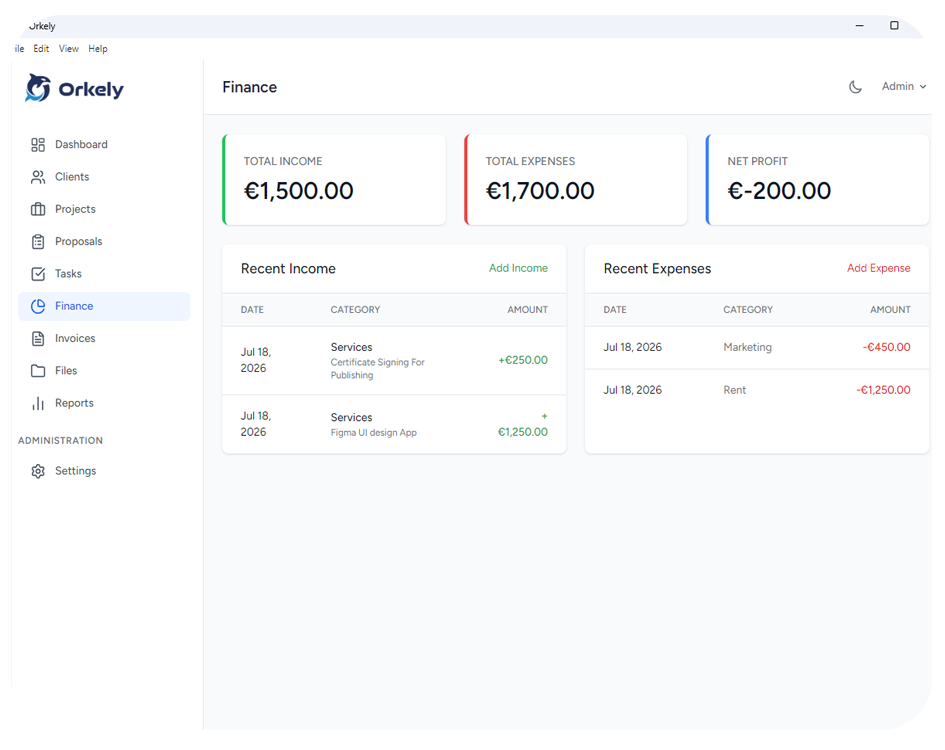
Orkely's tasks and finance tools can hold the relevant operational records. The calculation below is an illustrative manual review, not a claim that the app automatically computes your full project profitability.
Work through an example
Consider a fictional design job with a fee of €600, direct external costs of €80 and 16 recorded hours. Assume the amounts are on a consistent basis and exclude taxes for this example.
Subtracting direct costs leaves €520. Dividing €520 by 16 hours gives €32.50 per recorded hour before overhead, taxes and other business costs.
This figure is not net profit, take-home pay or an employee wage. It is one limited indicator for comparing similar work. The result also changes if you missed preparation time or included an amount the client has not agreed to pay.
Ask what explains the result
Was the scope larger than expected? Did a supplier cost more? Were there repeated revisions or a long approval process? Did you spend time learning a process that will be faster next time?
Choose a specific adjustment: improve intake, separate an adaptation from the base package, obtain supplier pricing earlier or change the review allowance. Raising every price without understanding the cause may leave the delivery problem unchanged.
Review several comparable jobs
One unusual project should not define your entire pricing model. Compare similar deliverables and note the conditions that changed.
Should I include my own time as an expense?
For planning, you can assign an internal value to time, but keep it clearly labelled. Its accounting treatment depends on your business structure.
Does a high invoice mean a good project?
Only after you consider the work and costs required to deliver it. Revenue alone leaves out much of the picture.
For additional reporting features, review the optional Reports & Proposals add-on. Start by keeping the underlying records consistent.